Made with Kleap
UNDERGROUND Get the map
Field notes ยท Volume I

A hundred and sixty years
beneath the city.

The Tube did not arrive. It was dug, in fits and starts, through Victorian clay and wartime rubble and a hundred planning committees. This is the broad arc โ€” the stations, the strikes, the maps, the rain.

1863
World's first underground railway opens
1890
First electric deep-level Tube
1933
Harry Beck diagram published
1940
Stations used as Blitz shelters
1968
Victoria line opens with ATO
2016
Night Tube begins service
Today
5 million passengers a day
Interior of Paddington Station showing its architectural elegance.
Plate 01
1863

The Metropolitan opens

On 10 January 1863, the Metropolitan Railway ran the world's first underground service between Paddington and Farringdon. Steam locomotives filled the cut-and-cover tunnels with smoke, and the early wooden carriages were lit by gas โ€” but 40,000 passengers rode on opening day, and the line paid back its investors within months.

A curved subway tunnel with tracks leading into the distance.
Plate 02
1890

Electric deep-level tubes

The City & South London Railway opened in 1890 as the first deep-level electric tube. Boring shield technology, borrowed from Thames Tunnel engineers, allowed 20 feet of cast-iron tunnel under the streets. The Central London Railway (1890) followed with the first electric trains on a larger scale, drawing maps that would become the first Tube diagram.

Wooden bench at Hammersmith station with the iconic Underground sign.
Plate 03
1908

Harry Beck's diagram

Electrical draughtsman Harry Beck sketched the Tube as a topological circuit โ€” colours, straight lines, angles of 90 and 45 degrees. TfL initially rejected the idea as 'too radical', then printed 7,000 copies in 1933. The diagram has been re-drawn a dozen times but the geometry has barely moved. It is, by some distance, the most reproduced map in the world.

Passengers at historic Baker Street Underground station.
Plate 04
1940

The shelter years

During the Blitz, deep-level stations doubled as air-raid shelters. Up to 8,000 people slept on the platforms of Clapham Common, Stockwell and others each night. Anti-aircraft guns were mounted on the roofs of stations; the Booker pupils' murals at Charing Cross were painted in 1940 to soften the concrete.

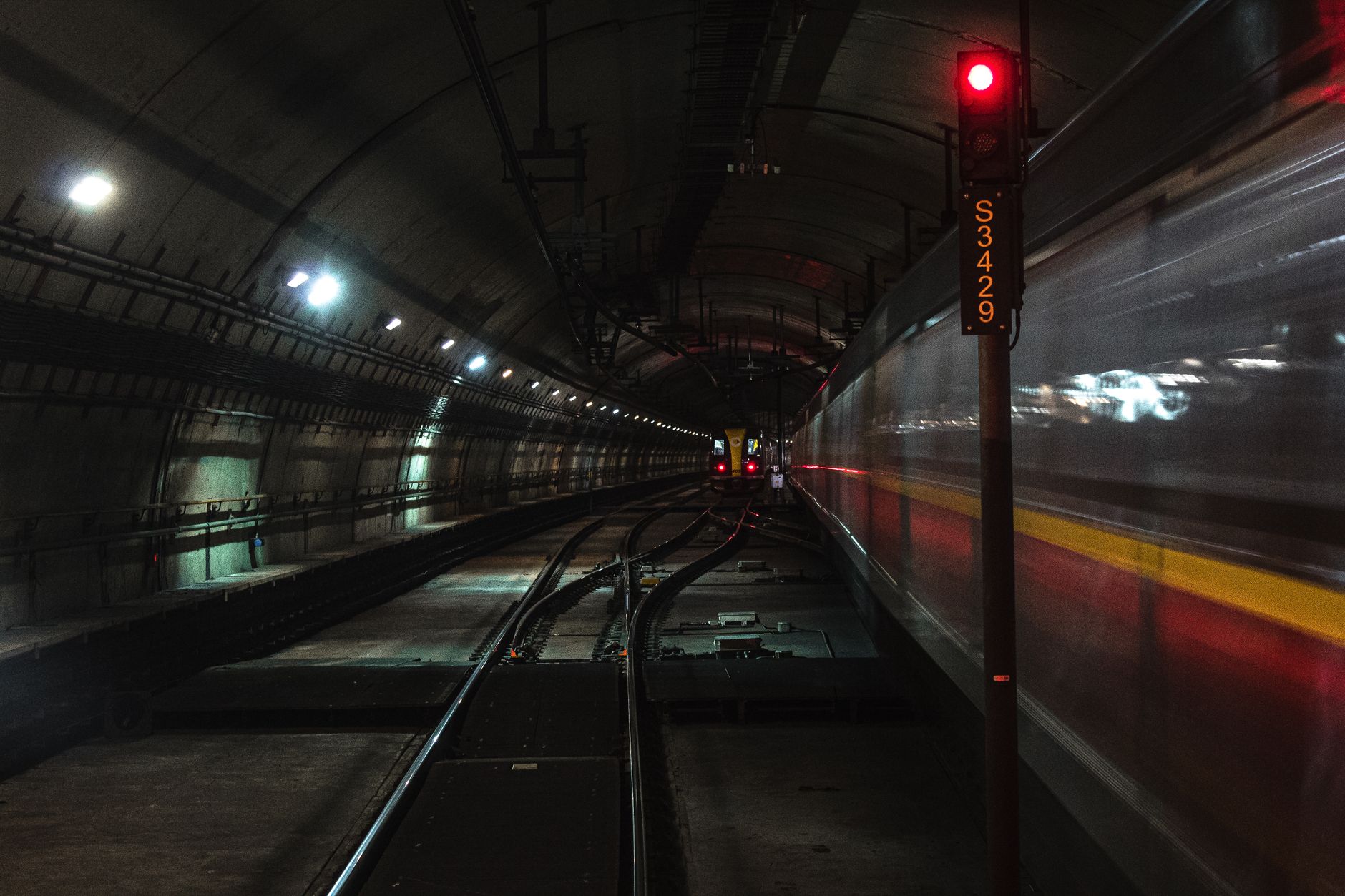
A dark view of a metro train passing through a tunnel.
Plate 05
1968

The Victoria line opens

The Victoria line, engineered with Automatic Train Operation from day one, opened on 1 September 1968. Walthamstow Central to Highbury & Islington first; Brixton followed in 1971. Deep-level Tube engineering had been pushed about as far as it could go โ€” the next generation would be deeper still.

Underground railway tracks disappearing into a tunnel.
Plate 06
2016

Night Tube begins

On 19 August 2016, the Central and Victoria lines ran through the night on Fridays and Saturdays. The Jubilee, Northern and Piccadilly lines joined over the following months. London was the first major city to run its metro overnight at scale, and the launch was driven as much by night-economy demand as by commuter maths.

The Roundel

Drawn in 1908, still in service today.

Frank Pick, the publicity manager of the Underground Electric Railways Company of London, commissioned the bullseye mark in 1908. The bar at the centre was added in 1919 so passengers would not confuse it for other transit signs. It has appeared on the side of every Tube train, every map, every escalator plate since.